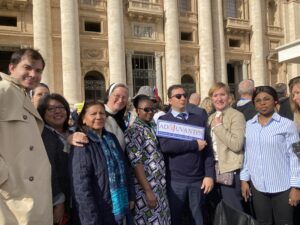
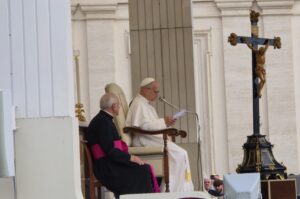
We are delighted to share this celebratory edition of the annual Adjuvantes Report with you, our supporters and donors, in this 25th year since Adjuvantes was founded. Our celebrations this year included the presence of some of you in a Jubilee Audience last October with Pope Leo XIV. Adjuvantes was founded because Fr Francesco Compagnoni, who was the Dean of the Faculty of Social Sciences at the time, realised that we needed to professionalise the way we were supporting our students, not least because the Italian Bishops’ Conference had decided to fund 10 full scholarships in our faculty for students from around the world as part of their follow-up to the World Youth Day 2000 in Rome that year.
In its 25 years of activity, Adjuvantes has developed new courses, forms of support for students, and innovative educational programmes, all in collaboration with the Faculty of Social Sciences at the Angelicum. One of its key innovative practices has been to bring together migrants, refugees and young people from deprived backgrounds who, despite these obstacles, have much potential and a strong desire to learn, with others who are high-flying and well-educated from Central and Eastern Europe. Putting them together in the
same classrooms has been illuminating and inspiring to both groups, in different and complementary ways.
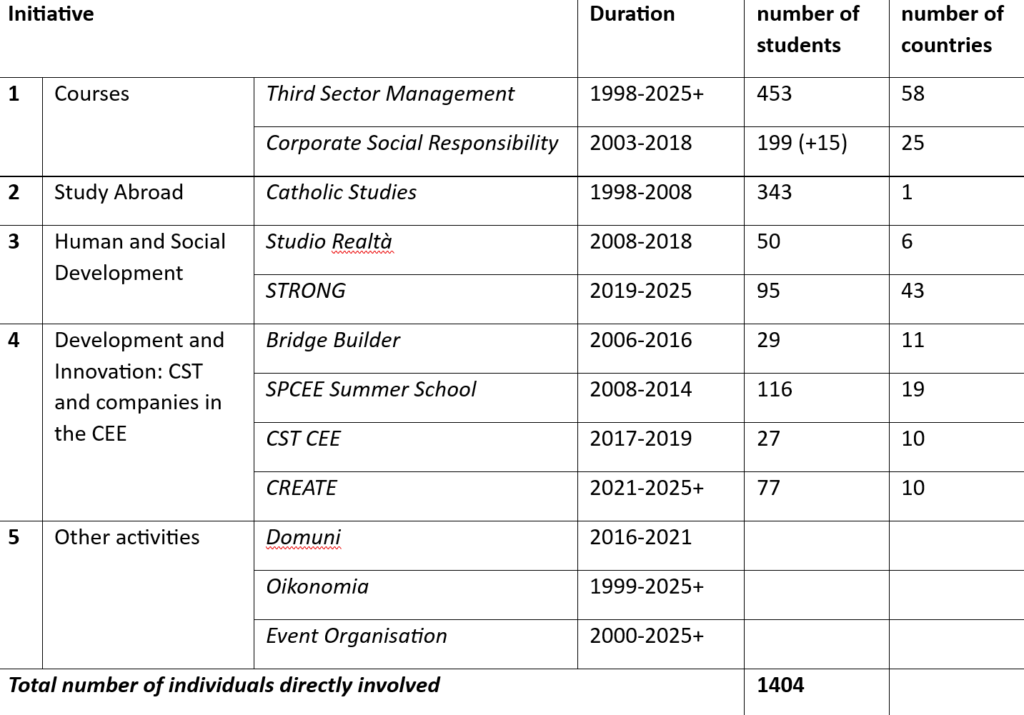
The work of Adjuvantes over the past 25 years can be divided into 5 categories of activity:
- Courses offered directly by Adjuvantes
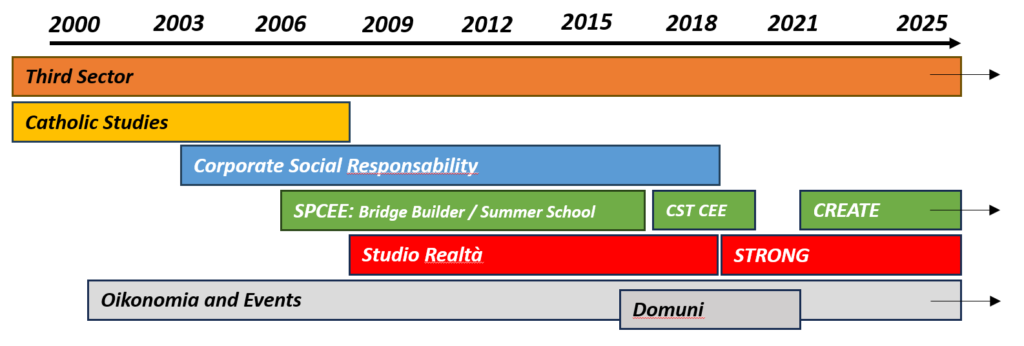
One of the first things Adjuvantes did was to take over the management of the annual advanced training course in the management of non-profit organisations and social enterprises that had been launched with the support of another organisation in 1998. This course was the first multidisciplinary and integrated programme in Italy to support and train professionals in the non-profit sector. Its strength and ongoing relevance are shown by the fact that it is still running today, 27 years later. It has provided training to 453 students from 58 different countries.
A few years after its foundation, in 2003, Adjuvantes launched a Master’s Degree in Corporate Social Responsibility. This initiative, also the first of its kind in Italy, was carried out as a collaboration between the Angelicum and the LUMSA, a private Catholic university that was founded by a community of Dominican sisters known as the “Missionaries of the Schools”. Adjuvantes, as the administrative partner of the project, ran the programme. Operating until 2016, when, in that form, it had to be discontinued because the Italian higher education system was changing its structure and master’s programmes were no longer attracting students, it had offered formation to 199 students from 25 countries. Adjuvantes attempted to keep the programme going in a different, more streamlined form, called an “Advanced Training Course”, which lasted for another two years and involved 15 more students.
- Study Abroad: The Catholic Studies Programme
The idea of “Catholic Studies” began with St. John Paul II’s apostolic exhortation Ex Corde Ecclesiae (1990), in which he called Catholic universities to deepen and renew their identity, promoting dialogue between faith and reason and an ethical perspective in study and research. As a result, in the academic year 1993-94, Prof. Don J. Briel, who was in the Faculty of Theology of the University of St Thomas in St Paul, Minnesota, launched the first interdisciplinary programme of Catholic Studies. Helen Alford, a future dean of the Faculty of Social Sciences here in the Angelicum, but not yet a Dominican sister, was a visiting professor at the same university that year, and was very involved in the launch of the programme. In 1996, now a professed Dominican sister, Sr. Helen was sent by her superiors to teach in the Faculty of Social Sciences at the Angelicum. When she arrived, she found the Dean of the Faculty, Fr. Francesco Compagnoni, teaching all the courses he could find across the system of pontifical universities in Rome in order to be able to distribute the money earned to students in need. At the same time, seeing that all this extra work meant that he could not do his job as Dean properly, she suggested that an agreement could be made with the Catholic Studies programme at St Thomas by which they could send their students to study in Rome, and some of the money gained could be used to support students. In 1998, therefore, the Catholic Studies Rome Programme was launched: a semester of study in which students could learn more about the richness of the Catholic intellectual, cultural and spiritual tradition as expressed in Rome and by a Roman Pontifical University, and experience an international environment that was both socially and culturally stimulating. The management of the programme was entrusted to Adjuvantes until 2008, when Catholic Studies became a programme in its own right. Over the ten years that Adjuvantes ran this programme, it provided a study abroad experience to 343 American students who undertook one or two semesters of study at the Faculty of Social Sciences.
- Programmes supporting and empowering migrants and refugees
As we know, Adjuvantes had been involved in supporting students in difficulty from the beginning, but around 2007, it started to imagine the idea of actively searching for, and helping to recruit, students who belonged to migrant communities in Rome coming from the same countries who were sending us students. These migrant communities were also often marginal and excluded, and working together, we thought that these two groups of students would be able to help each other. In this way, the ‘Studio Realtà scholarship programme was born. Active from 2008 to 2017, it went through three stages of development. Firstly, we aimed to promote the formation of current and potential leaders in the immigrant communities. We searched for people who wanted both to be able to understand their cultural roots better, and thus be in a better position to enrich society as a whole with what their culture had to offer, as well as to be able to work towards more integration of their national group into the local, Roman culture. As a result, seven people from seven different countries joined the project in its first year. However, problems quickly emerged. These people were working full-time as well as studying; they got behind and became discouraged. We felt these negative results were the opposite of what we were trying to achieve; it was clear that our programme of studies was too heavy for most of them. As a result, we suspended the programme until we could find a better way of carrying it forward. In a second stage, we realised that, of the first seven students, one or two did do well and were genuinely able to cope with the stresses of combining work, family and studies, and that we could still try to run the programme for students like these. In 2011, therefore, Studio Realtà was restarted informally. Instead of publicising it widely, as we had done before, we asked students who had demonstrated that they could cope with the demands of the project to propose other candidates. As a result, we recruited a couple of new students, who also did well. However, this approach was not able to achieve much as regards the original aims of the project. Finally, in a third stage, we realised that we could use the principle of solidarity; we decided to recruit “cohorts” of up to 5 students from the same migrant community, who would go through the study programme together and support and help each other with all the difficulties they faced. This approach worked very well, and we were able to recruit cohorts from Ukraine, Moldova, Romania and Albania. Overall, then, by the time the programme finished – as we explain below, it developed into the STRONG programme – it had provided formation to 50 students, both at the first and second cycle level (i.e. the bachelor’s degree level and the level of the licentiate/master’s degree), and also in the Non-Profit Management course run by Adjuvantes, as presented above.
The STRONG Scholarship programme was the “daughter” of “Studio Realtà”. In 2018, we ran an extensive evaluation of Studio Realtà involving an external research institute. Their report was then used in a process of “participative project design”, where current and former students, and other potential stakeholders, worked with us to put together a new programme to support the integration of migrants, one which was able to build on what we had learnt from Studio Realtà. We were able to launch the new programme in December 2018, alongside the signing of the Global Compact on Migration to which Pope Francis had given so much attention, signalling our support to the Holy Father and his initiative. Running from 2019 to 2024, STRONG funded studies at the Faculty of Social Sciences, mainly at the first cycle (bachelor’s degree) level, for citizens with a migrant background or their children, known as “second-generation” immigrants, including an integrated support programme that helped them learn how to do empirical social research in the field, gave them career guidance and mentorship opportunities, and helped them develop and strengthen the social networks of the migrant communities themselves. STRONG scholarships provided formation to 95 students from 43 different countries across all the continents.
- Programmes promoting high-flyers and social innovators from Central and Eastern Europe (CEE), working within the tradition of Catholic Social Teaching (CST)
Like our programmes to empower migrants, this complementary line of activity has also been through three iterations. The connection between Adjuvantes and young scholars from Central and Eastern Europe had existed from the beginning, as the earliest Adjuvantes report from 2001 demonstrated. Later, thanks to the initiative of one of our major donors, Adjuvantes started to develop a specific project focused on forming high-flyers from the region. We therefore signed up to their “Scholarship Programme – Central and Eastern Europe” (SP-CEE), and participated in it by giving formation at the licence and doctorate level, via an Adjuvantes programme called “Bridge Builder”, as well as running summer schools for a wider group of SP-CEE scholars. Active from 2006 to 2016, “Bridge Builder” provided formation for 30 students from 11 different CEE countries, while the ten-day long summer schools trained a total of 116 students, including 22 who were also enrolled in Bridge Builder.
The second iteration in this line of activity was the “CST-CEE” scholarship programme. Running from 2018 to 2021, along with support given to students from CEE countries in degree programmes and summer schools, it also created networks of professors from universities and institutions in CEE countries, forming an international and multidisciplinary working and research group with the aim of creating synergies between CEE countries, developing innovation, and disseminating good practices in the application of CST to key social challenges. A total of 16 students and 11 professors from 10 different CEE countries were involved.
The current form of this initiative is the CREATE Scholarship programme, which began in 2021 and is still ongoing. It is divided into several areas of action: “CST Toolbox” [TX], a semester of study at the Faculty of Social Sciences, with visits to international institutions and to offices of the Holy See in Rome; “Laudato Si scholarships” [LS], with funding for doctoral and post-doctoral studies at the Faculty of Social Sciences; “CREATE Prize” [CP], an annual award for the best essays published in a volume on topics regarding the application of CST in the CEE region; “Expert Council” [EC], providing consolidation of the international network of CST Experts built up through the previous CST-CEE initiative. At present, we are focussing CREATE on the post-doctoral component. To date, the programme has involved 77 participants from 10 different CEE countries.
- Other research and development activities
Domuni: from 2016 to 2021, Adjuvantes designed and developed four professional diploma programmes in the Italian section of the Dominican Online University, Domuni, based in Toulouse (France): (1) Catholic social thought and Contemporary Society; (2) FIX – Integral Christian Formation; (3) Social Ethics; (4) History of Christian Art.
Oikonomia: Adjuvantes edits and publishes the journal OIKONOMIA: Rivista di etica e scienze sociali / Journal of Ethics & Social Sciences. The journal, active since 1999, is registered with the Court of Rome, no. 422/2002 of 12 July 2002, ISSN 1720-1691, and is published online three times a year at the address: https://www.oikonomia.it/