


As you know, we did not manage to send you a report over the last three years. If I am honest, it is mostly because I (Sr Helen) was elected Vice Rector at the end of 2017, as well as Vice Dean of the Faculty of Social Sciences, so the amount of work increased a lot for me. Nevertheless, we should have found a way to keep reporting to you! Anyway, as the phrase goes: “better late than never”: in this report we will give you feedback over the last three years, with the relevant accounts.
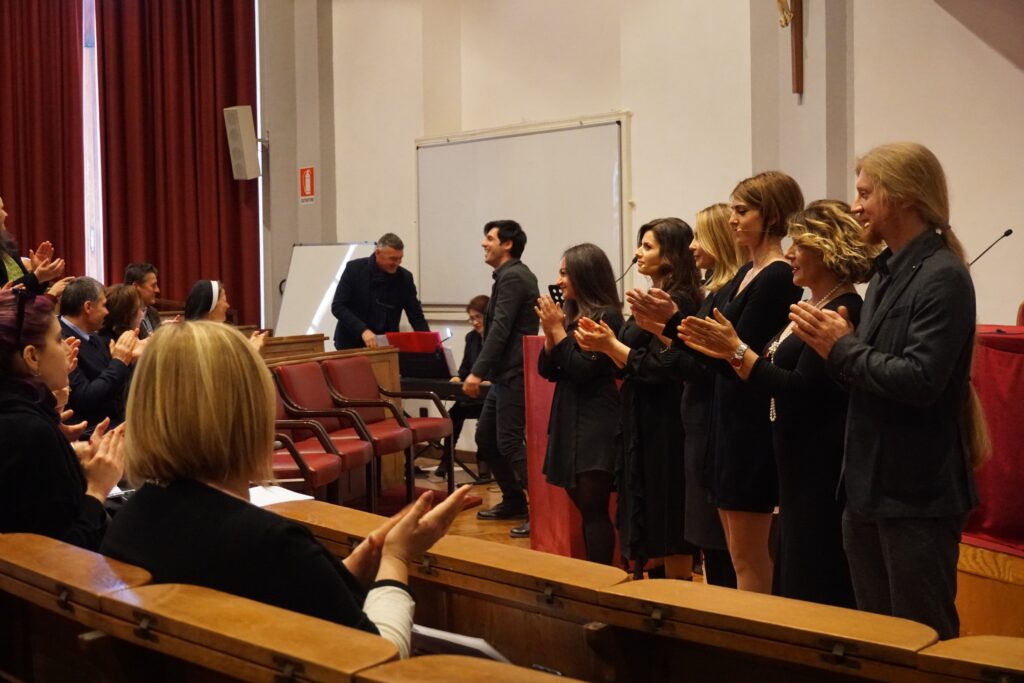 One of the main developments that occurred over this period is that we concluded the “Studio Realtà” programme of scholarships, with the last students in the programme completing their degrees in June 2020. Over the three years of this report, 20 students were given formation with the support of Studio Realtà. One of the highlights was the dramatic presentation of the ethnographic research that the Romanian students in the programme had carried out, covering the lives of Romanians in Rome. This special event, held in March 2019, involved the reading and dramatic presentation of parts of the stories our students had collated and it drew a large audience from among the immigrant communities in Rome. It was a very powerful, involving many members of the Romanian community. The year before, in 2018, we had run a very extensive evaluation of Studio Realtà, involving an external research institute. With our help, they contacted all the former and current students of the programme so that they could complete an anonymous questionnaire. They also ran some focus groups to get richer feedback from students. Their report was then used in a process of “participative project design”, where current and former students and other potential stakeholders worked with us to put together a new programme to support the integration of migrants which was able to build on what we had learnt from Studio Realtà. As a result, we were able to launch STRONG, a kind of “daughter” programme of Studio Realtà, in December 2018. It was important to do so at that point because in the same month the international “Global Compacts” on Refugees and Migrants were signed by many countries, the crowning result of a process that the Holy Father had been strenuously supporting. By launching STRONG at the same time as the compacts were signed, we were signalling the support among the Pontifical Universities in Rome for the Holy Father and his initiative.
STRONG is an acronym of the activities that are included in the programme: Selection, Training, Research, Orientation (to the workplace), Networking, Global monitoring and control. The “Selection” activity is time-consuming, but represents a very important part of this programme (and an advance on Studio Realtà, because we did not put so much effort into the selection process at that time). A “Call for Applications” is now sent out through an ever-expanding network of associations and organisations in order to offer opportunities for formation to as wide a group of students as possible. Every person who applies is given an interview of 30 minutes with three of our lecturers, allowing us to listen to each of them and to give them advice and support. This helps to build their confidence and their sense of dignity, even if at the end we cannot give them a scholarship (to give you an idea: in the most recent selection process, we had 40 applicants and 16 scholarships available). Other improvements compared to the Studio Realtà programme include the chance for students to participate in a research project, helping to learn how to do social research, and the inclusion of career orientation and advice, both in groups and on a one-to-one level. We will tell you more about these and other aspects of STRONG in subsequent reports.
In the last report we sent you (around Easter 2018, with financial accounts from 2017), we told you that we had done some research into the teaching of Catholic Social Thought in Central and Eastern Europe, and that we would be using the results in further work. Later that year we were able to launch a new programme called simply “Catholic Social Thought in Central and Eastern Europe (CST-CEE)”, which involved a small number of scholarships for students from Central and Eastern Europe to study with us, as well as a Summer School for students from the region and an “Expert Council” involving professors of Catholic Social Thought from several of the higher education institutions across the region. Two of the students, who have completed Licence programmes with us as part of CST-CEE tell us something about themselves below.
I am Réka Mohay, a 26-year-old theologian and economist from Hungary, Pécs. I have often been asked if my two degrees were compatible with each other. I would always say, “of course”, but in the past years I have realized they are inseparable and crucial to each other.
Coming to study in Rome was something that happened as kind of a surprise – or rather as a gift – to me. I was not really aware of this possible future when I received the call for application from my theological college, to participate in a program in Rome, called “Catholic Social Thought – Central Eastern Europe (CST-CEE)”. I sent my CV being a bit unsure if I would be chosen. Nevertheless, some months later I received confirmation that the Angelicum was waiting for me!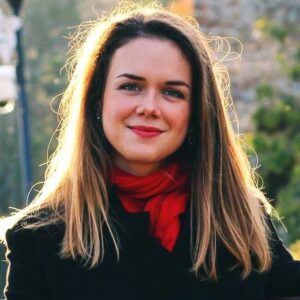
It was not easy to move to a new country and arrange everything to be able to come, but I could not say no to such a great opportunity – now I know it was fully worth it. On the one hand, the program I was invited to take part in has aroused my interest from the very beginning: to study at the Faculty of Social Sciences and make connections with other Central Eastern European students, and moreover to deepen my knowledge of Catholic Social Thought, learning about its application to various fields, mainly in the Economic sector. On the other hand, I have always been fond of Italy and Rome, a city which despite being enormous, is a place where I feel at home and cannot help but be amazed at all the treasures and beauty that it has to offer. So, in February 2019, I found myself in the “Eternal City”, starting one of the biggest adventures of my life.
In the years of the programme, besides learning Italian which was a completely new language for me, I attended various courses, took part in interesting international events and conferences, the FASS’s Summer School, focusing especially on the implementation of Catholic Social Thought in Central Eastern European countries, and I have also attended the specialised Master’s course on the Third Sector. I made new friends and lots of memories, visited some stunningly beautiful cities, churches and museums. Studying here has helped me deepen my knowledge and broaden my horizons.
For my thesis topic I chose “Humanistic Management”, focusing especially on a management style inspired by Christ. This idea was partly inspired by the work of a Hungarian Jesuit priest, Ulrich Kiss, a former manager of L’Oreal, who gives lectures and formation programmes for managers and CEOs, entitled “Management by Jesus”. I would also like to include the ideas of Luigino Bruni on the regarding the role of “gift” in the economy. In the future I hope I will have the opportunity to share my knowledge with others, helping to make these ideas become even more widespread and popular in my home country. I believe that every effort made to form a more humane society and economy is a step towards the Kingdom of God.
Réka Mohay
My name is Iuliu-Marius Morariu. You might be wondering why I, a young Romanian hieromonk, would leave my country and come to Rome when I had just been appointed as the spiritual father of a beautiful monastery of sisters in Cluj and had many other things to do in the area of research and spiritual life? It is difficult for me to say. Maybe it was because of my commitment to study, a fascination for Rome, or who knows what other reason… I still do not have an answer, but I know that I will never repent of this decision. After a long process of evaluation of my transcripts and an interesting Summer School dedicated to Catholic Social Teaching, the Angelicum Pontifical University finally accepted me as a Licence Candidate in the Faculty of Social Sciences in July 2018.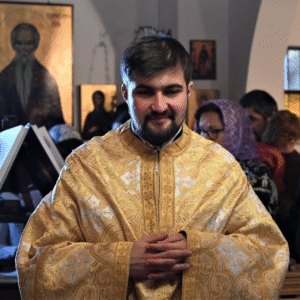
What did I find there? First of all, a great place with a family atmosphere. While Sr. Helen has always a smile and some words of encouragement for everyone, Miss Marina is always disposed to help you, and Valerio was like big brother for me, especially in the first days. Of course, we are there students from all around the world and the cultural enrichment is not a story, but a real fact. Professors and scientific events are always present and people like Fr. Francesco Compagnoni, Fr. Alejandro Crosthwaite and many others make our life beautiful by teaching useful things in a very inter-disciplinary way. In the beginning, when my knowledge of Italian language was very poor, I was also very happy to find there a few Romanian colleagues that shortly became my friends.
Of course, the classes are quite different from what I have studied before (and I have studied in Cluj, Geneva, Belgrade and Graz) and this is very good. I will always remember the class of “Etnia, popoli and cinema,” held by Father Alejandro, that gave me the possibility not only to watch good movies, but also to understand them in a different way, and many other classes that really helped me to develop research and spiritual skills. For sure this wouldn’t be possible without the rich library of the university, where a student who wants to read or to research can find not only the latest important journals on theology, sociology, history or politics, but also a huge amount of older or newer books. For a man like me, who feels like a fish in water inside a library, this was an important element which, together with the social events, helped me to integrate myself into my environment, learn the Italian language and prepare for the exams!
Therefore, I am grateful to the Faculty of Social Sciences of Angelicum for the possibility to study there and for the fact that I was helped to feel not only as a student, but also as part of a great family where the garden helps you to meditate, and the classes to learn about God’s creation and the way that you can use it properly.