Last year, we briefly presented our two “flagship” programmes, STRONG and CREATE, including the stories of two of the students who had recently graduated as part of STRONG.
Following on from those personal experiences, this year we present to you the key results of a survey we did of all the students who had participated in STRONG since it started in December 2018. We wanted to see how well we were achieving the three outcomes we had said we would try to achieve. It is very important to know that all the students who replied to the survey had already completed their degrees with us, so they had no reason to answer more positively than they really felt. 
Outcome A1: A group of “exemplar” migrants or children of migrants who have been empowered through the formation they receive as part of the STRONG programme and who become living examples of ways to confront the challenges they face, and signs of hope to their peers and members of the host population.
In order to check how well we had reached this outcome, we asked our students to rate how much they had been helped in relation to their empowerment, self-esteem, leadership skills, social recognition, hope in the future and their capacity to give hope to others.
We found that, in each case, over 90% felt that the programme had helped them either “a lot” or “somewhat”. For example, here is the pie chart of how well they rated the statement “I can now give more hope to others”.
Outcome A2: Wider, deeper and more advanced cooperation between civil society organisations, government institutions and market players, creating the possibilities for real improvements in the labour market situation faced by migrants and in the possibilities for their civil and political participation in Rome.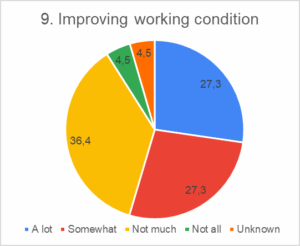
Here we asked them to rate two groups of three statements: the first group dealt with their capacity to present themselves to employers, to help others to do the same, and whether they had actually been able to improve their work situation as a result of the programme; the second group dealt with their capacity to participate in civil society, to join in local political decision-making processes and whether they had been able to improve relations that the civil society organisations to which they belong have with other actors, especially local government.
We were delighted to find that half of the respondents improved their working conditions, which, given the labour market situation in Rome, is quite significant; furthermore, more than 90% feel more capable to deal with the labour market and can help other people in finding employment. About 90% report better participation in civil society and in local decisional processes, while 77% had the opportunity of improving the relationships between their associations and local governmental institutions.
Outcome A3: Reinforcement of the work being carried out by Pope Francis and the Migrants and Refugees section of the Dicastery for the Promotion of Integral Human Development, by making available in Italy, and to the various home states from which the migrants come, qualified people who are able to be an active part in putting the two new Global Compacts into practice.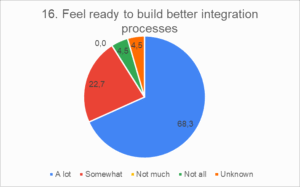
In relation to this outcome, we asked the STRONG graduates how well they now understood the Global Compacts on Migrants and Refugees and, more generally, what the Church is doing to support migrants, as well as how willing they would be to participate in programmes implementing the Global Pacts, and whether they felt more capable after participating in STRONG to be part of dialogues and processes promoting the integration of migrants, and of promoting the development of the diaspora communities and their members to which they belong.
We found that more than 80% of the respondents report a better understanding of the objectives of the Global Compacts and of the role of the Catholic Church in supporting migrants; more than 90% express greater interest in participating in the implementation processes of the Global Compacts, in particular as regards the better integration of migrants and the development of diaspora communities.
To complete the picture of the STRONG programme, here is some data regarding the programme overall.
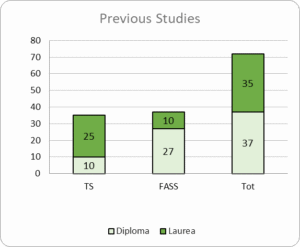
Since 2018, we have had 72 students in the programme, 37 in the bachelor’s degree and 35 in the professional course for the management of civil society organisations.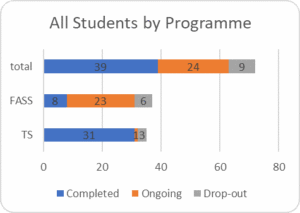 Unsurprisingly, students from migrant backgrounds, some of whom are refugees, constitute a fragile group, and not all of them manage to finish their degrees.
 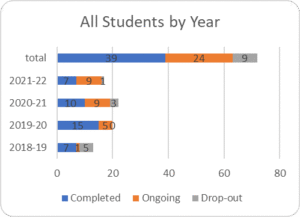 At the same time, an overall drop-out rate of 13% (meaning 9 people out of the 72 in the programme) is not unusual for academic programmes in general.
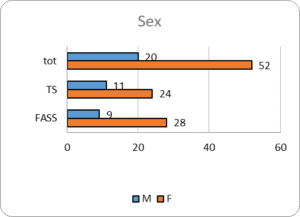
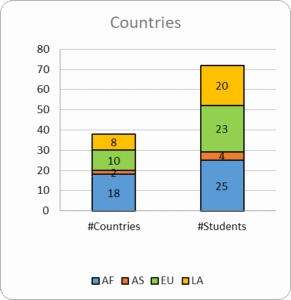
We have a large age range of students, with two peaks around the ages of 30 and 45-54; women constitute around three quarters of the group, while the parts of the world from where the students come are largely Africa and Europe, with a slightly smaller group from Latin America and a rather small group from Asia.
Students come from 38 different countries, with 35% from Africa, 32% from Europe, 28% from Latin America, 6% from Asia. The biggest national groups are from Ukraine (7 students), Perú (6 students) and Venezuela (4 students), making up 24% of the total number of students.
A majority of the students registering for the bachelor’s have no previous higher education, whereas over 70% of those registering for the professional course do have some prior tertiary level education.